The Role of a Team Leader in a Reactive Organization: How to Lead When the Company is in "Firefighting" Mode
03/18/2026Reading time: 8 minutes
What you will learn from this article:
- What organizational resilience is and why it is critical today.
- The link between Business Continuity Management (BCM) and Crisis Management.
- What happens at the reactive level when leaders operate in permanent firefighting mode.
- The natural resistance to change in high-pressure environments.
- The hidden cost of reactivity: Convenience vs. Responsibility.
- The practical role of the Team Leader as a "system stabilizer."
- The greatest risk: "Organizational Heroes."
- A checklist for Team Leaders to build resilience starting tomorrow.
Introduction
In reactive organizations, it is not procedures, but Team Leaders who serve as the first real mechanism for building resilience. Today’s organizations operate in an environment of permanent volatility—operational disruptions, reputational crises, broken supply chains, or sudden regulatory changes are no longer exceptions; they are the norm. In this context, organizational resilience—the ability to survive, adapt, and grow despite unpredictable events—becomes a key concept.
However, many companies—especially young ones or those managed strongly by intuition—still function at a reactive level. They don't plan; they react. They don't predict; they extinguish fires. This is precisely where the role of the Team Leader becomes critical.
In short:
- Organizational Resilience = The ability to survive, adapt, and learn.
- Reactive Level = Lack of plans, acting under pressure, "here and now" decisions.
- The Team Leader's Role = Acting as "local system stabilizers." Their actions decide whether chaos turns into controlled adaptation.
What is Organizational Resilience and Why is it Key Today?
Organizational resilience is more than just the ability to "bounce back" after a crisis. It is:
- The ability to maintain business continuity.
- The ability to adapt during a disruption.
- The ability to learn after the event.
Research shows that resilience is directly linked to the quality of leadership, adaptability, and organizational culture.
The Link Between Business Continuity Management (BCM) and Crisis Management
Resilience is often treated as an abstract, "strategic" concept. In reality, it has a very concrete operational dimension based on two pillars: Business Continuity Management and Crisis Management.
Business Continuity Management (BCM)
In mature organizations, BCM does not start at the moment of crisis. It starts much earlier, when someone asks: "What happens if something goes wrong?" This approach translates into:
- Creating procedures for disruptive situations.
- Preparing contingency plans.
- Developing scenarios for various types of disruptions (operational, technological, personnel).
Most importantly, the organization learns to think in terms of risk and consequences. As a result, when a real problem arises, people know the priorities, decisions are faster, and chaos is limited.
Crisis Management
Crisis management is the "moment of truth." It verifies whether communication works, whether leaders can make decisions under pressure, and whether the team understands what to do. It requires rapid response, clear messaging, and decision-making even with incomplete data.
Crucially: Even the best procedures won't "work by themselves." It is the people—and primarily the leaders—who give them meaning.
What Happens at the Reactive Level?
The problem in reactive organizations is that these areas exist only in theory or not at all. There are no real plans, no practiced scenarios, and no agreed communication methods. Instead, the mindset is: "We'll handle it when it happens."
Example: A logistics company suddenly loses access to a key IT system.
- Mature Organization: Has a backup plan, clear decision-makers, and ready customer communication.
- Reactive Organization: People try to "bypass the system" on their own, conflicting messages emerge, and customers find out with a delay.
The result: The chaos surrounding the problem becomes a bigger threat than the problem itself.
The Hidden Cost: Convenience vs. Responsibility
A reactive, authoritarian model provides a false sense of control. Decisions are fast and responsibility seems "clear." However, the cost is high:
- Middle management fails to develop decision-making skills.
- Line leaders don't learn risk management.
- The organization fails to build resilience mechanisms.
This leads to a paradox: The more an organization relies on one strong leader, the less resilient it becomes. Resilience comes from dispersed knowledge and the ability of many people to make decisions independently of the "top."
The Practical Role of the Team Leader
In a reactive organization, the Team Leader sits between two worlds: executing "top-down" orders while managing the operational reality. This is where resilience building begins—through micro-decisions.
Example: An IT Incident Team A reactive leader just passes tasks along. A Resilient Leader establishes clear prioritization criteria, introduces 10-minute daily huddles, and streamlines communication with stakeholders.
Infographic 1: The Team Leader as an Organizational Resilience Stabilizer
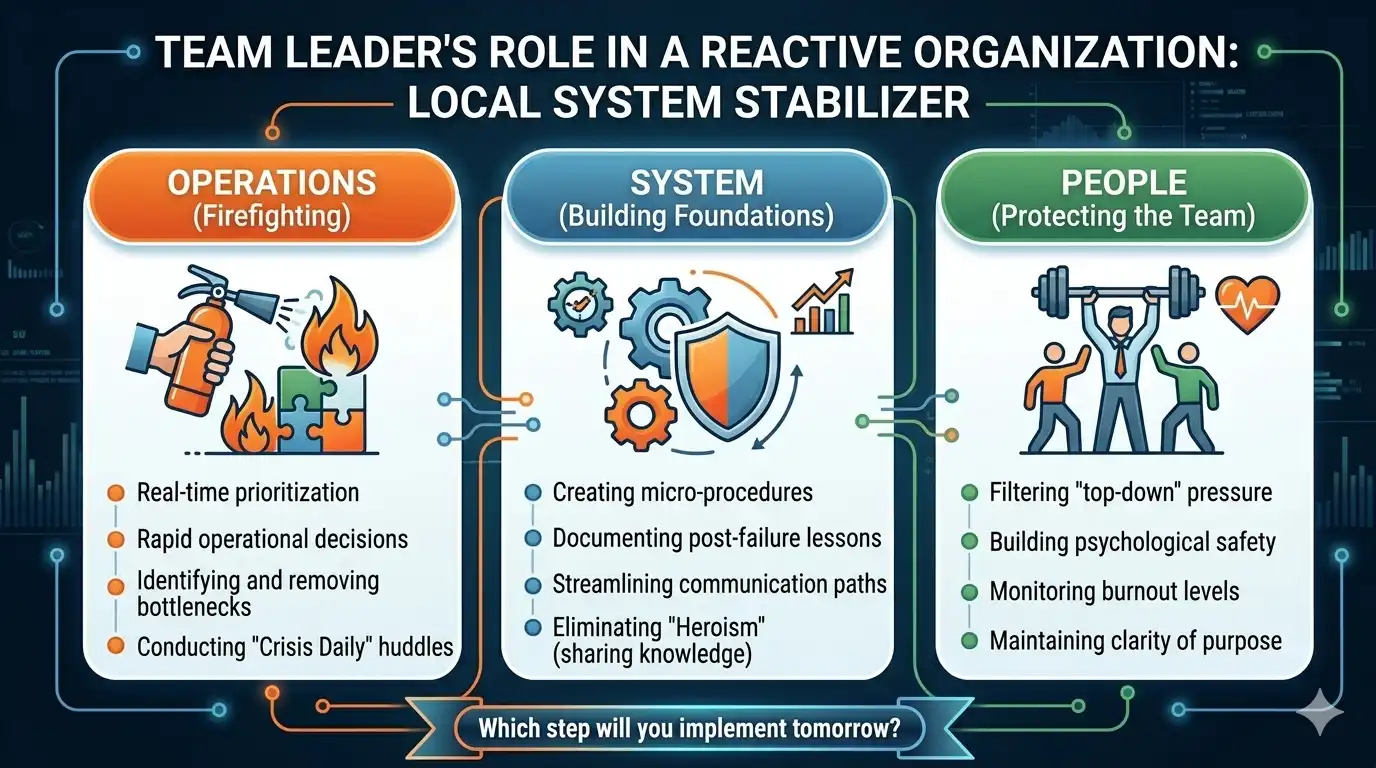
- OPERATIONS (Firefighting): Managing the current crisis through radical prioritization and quick decisions.
- SYSTEM (Building Foundations): Documenting lessons from failures and creating "mini-procedures" for recurring problems.
- PEOPLE (Protecting the Team): Building psychological safety (errors are lessons) and monitoring for burnout.
The Greatest Risk: "Organizational Heroes"
Reactive levels often breed "heroes"—individuals who "always deliver" and save the day. While valuable, they are a systemic risk. If knowledge is not transferred and processes aren't created, the organization becomes dependent rather than resilient.
Moving Beyond the "Firefighting" Phase
Being reactive isn't a mistake—it's often a natural stage of growth. The problem is staying there too long. To grow, an organization must transition:
- From "Reacting" → to "Predicting"
- From "Boss Decides" → to "Leaders Decide Locally"
- From "Firefighting" → to "Designing the System"
Checklist: What can a Team Leader do "from tomorrow"?
- [ ] Conduct a quick daily risk review (15 min).
- [ ] Set 3 clear daily priorities for the team.
- [ ] Simplify communication (What / Who / By when).
- [ ] Document decisions and lessons learned.
- [ ] Build "mini-procedures" for recurring issues.
Which point will you implement tomorrow?
Summary
Organizational resilience is not a declaration; it happens in practice. It’s about who makes decisions, whether leaders allow teams to think independently, and whether mistakes are analyzed or swept under the rug. In a reactive organization, the system of resilience might not exist yet—but the Team Leader can build its foundations.
Author: Barbara Matyaszek-Szarek This article was created with the support of AI technology for data structuring and graphic visualization.